Two variants, one age-aware core
A³L-FEC comes in two forms. FSFB is the simpler baseline with fixed parameters; VSVB is the adaptive version designed for dynamic, lossy networks. Both run over UDP and minimize age violations with receiver-driven feedback.
A3L-FEC-FSFB
Fixed Sampling Rate and Fixed Block-length
The baseline variant operates in a time-slotted status-update system over an error-prone link. The source generates samples at fixed intervals, and each sample is coded with a fixed block length n. The transmitter buffers only the most recent samples and chooses which chunks to send using a Stationary Independent Selection (SIS) policy that provably prioritizes fresh updates.
- Optimal selection probabilities derived for a given expected rate
- Samples older than AVT are filtered out before transmission
- Receiver feeds back rate from age violations and average delay
- Simple, analyzable, and a strong reference point for evaluation
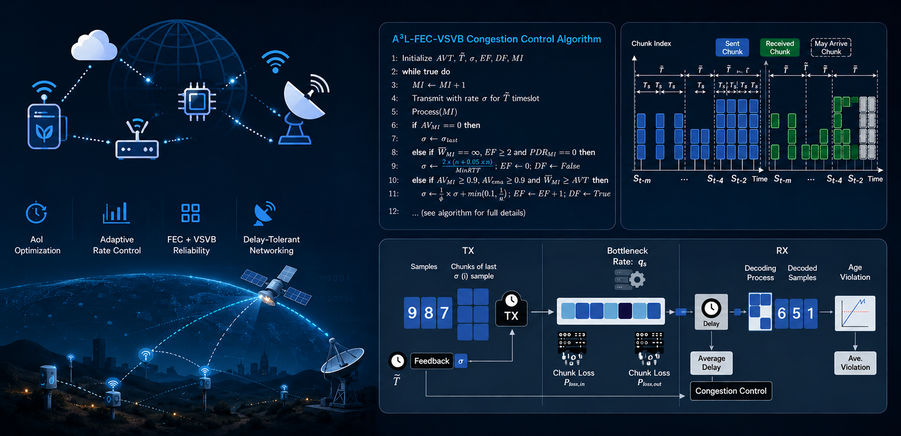
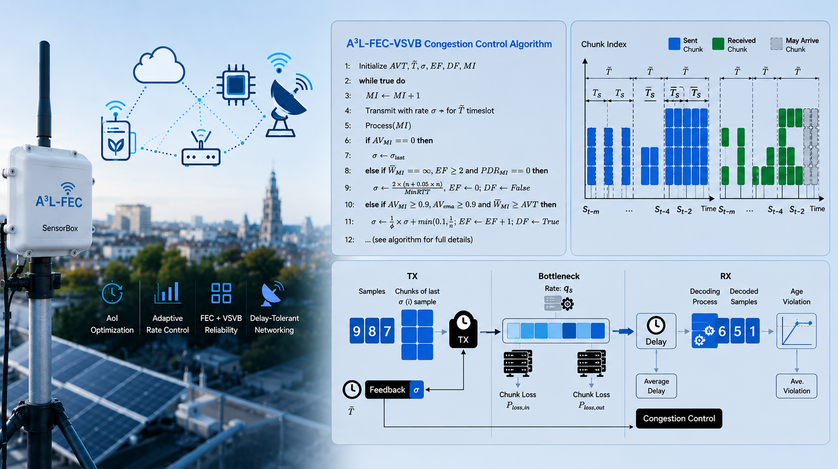
A3L-FEC-VSVB
Variable Sampling Rate and Variable Block-length
The adaptive variant follows a "generate-at-will" model: the source generates a sample only when the policy permits, and both the sampling interval Ts and the block length n can change every monitoring interval. At each interval the receiver recomputes age violations, average delay, packet delivery ratio and min-RTT, then selects the block length that minimizes age violations and updates the sampling interval and rate.
- Refined age-violation estimate from generation/decode-time lists
- Optimal block-length search each interval (redundancy vs delay)
- Emergency responses for empty pipeline and congestion onset
- Fire-and-forget transmission keeps delay near propagation delay
When to use each version
- Link conditions are relatively stable or well-characterized
- You need a simple, analyzable baseline or reference implementation
- Sampling rate and coding parameters can be fixed in advance
- Constrained devices where minimal logic is preferred
- Network conditions vary (mobility, fading, changing load)
- Loss and delay are significant and time-varying
- Delay-tolerant or long-path links (incl. challenged networks)
- You want the lowest age violations and most stable delay
Reported results indicate that VSVB generally achieves lower age violations and more stable delay than FSFB under variable conditions, because it continuously retunes its sampling and coding. FSFB remains valuable as a lightweight, interpretable baseline and as the foundation that motivated the adaptive design.
Dive into the numbers
Side-by-side results for FSFB, VSVB, TCP-BBR and ACP+ across MATLAB and Mininet-WiFi.